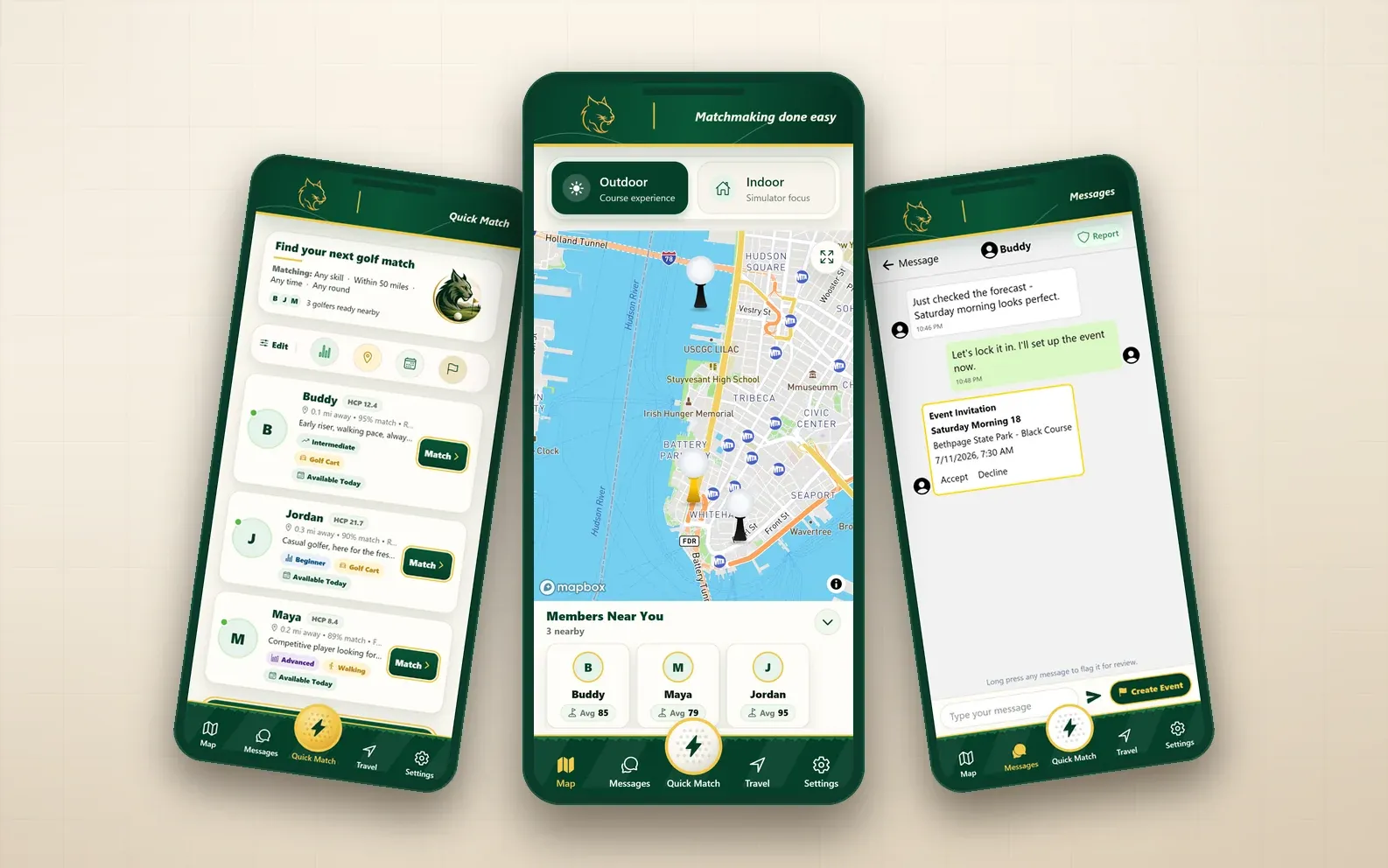
GameLynx
A skill-based matchmaking app that pairs golfers with compatible playing partners nearby, then gets the round on the calendar.
In development — store listings in progress
- React Native
- Expo
- TypeScript
- React 19
- +5 more
MVP development for startups
A first version scoped to answer the one question your idea actually depends on — built to ship, not to demo.
Two failure modes kill first versions. One builds everything, launches in fourteen months, and discovers the assumption was wrong. The other builds a prototype so thin nobody can tell whether the idea works, and the result proves nothing either way. Both spend the same money.
We find the single riskiest assumption and scope the build around testing it. Everything else waits. That means saying no to features you will genuinely want later — worth it, because a version that ships in three months and teaches you something beats one that ships in twelve and does not. Built on foundations that can carry version two, not throwaway code.
The useful question at the start is not “what should it do” but “what would have to be true for this to work, and how would we find out cheaply”.
Discovery is built around answering that in writing before anyone opens an editor.
From real projects
Each of these is drawn from a case study on this site, not from a hypothetical.
Case studies
A skill-based matchmaking app that pairs golfers with compatible playing partners nearby, then gets the round on the calendar.
In development — store listings in progress
Small enough to build in weeks, complete enough that a user gets real value without you explaining it. If a user needs a walkthrough to understand the point, it is a prototype, not an MVP.
Not if scope is what is minimal rather than quality. We cut features, not the data model, the tests, or the deployment. Those are what make version two cheap.
No. Fixed-price milestones, so you can stop between them.
Then it did its job, at a fraction of the cost of finding out later. That is the point of scoping around an assumption.
Related
Start with a discovery call. It costs nothing to find out whether this is the right shape of work for your situation.
Prefer email? Contact@DeviceBytes.com